Index 01 · Solo exhibition
Roaming in the Paracosm
- Venue
- Cub_ism_ Artspace, Shanghai
- Dates
- 28 Dec 2024 – 22 Feb 2025
- Role
- Curator
- Works
- Fifteen paintings · cat sculptures
Fifteen paintings and a handful of cat sculptures, hung as three loose rooms — Wildmen, Film and Animals. Highly saturated colour raises the tension; thinner dilutes it until the edges of things come loose. Tap any work to look closer.
From the exhibition text
The artist paints with the restlessness of their generation — bold, fluid strokes and a loose, almost reckless use of thinner that lets pigment run until figuration slides toward abstraction.
Photographs and film stills are collaged, dissected and re-staged — not rearranged so much as anatomised, then handed back as image. Slogans surface in the paint, deliberately misspelled or broken apart, scattered across the canvas like off-screen subtitles to the scene.
“My work is how I watch the things of this era — and think them through on my own terms.” — The artist
The hang
Three rooms · Wildmen — Film — Animals
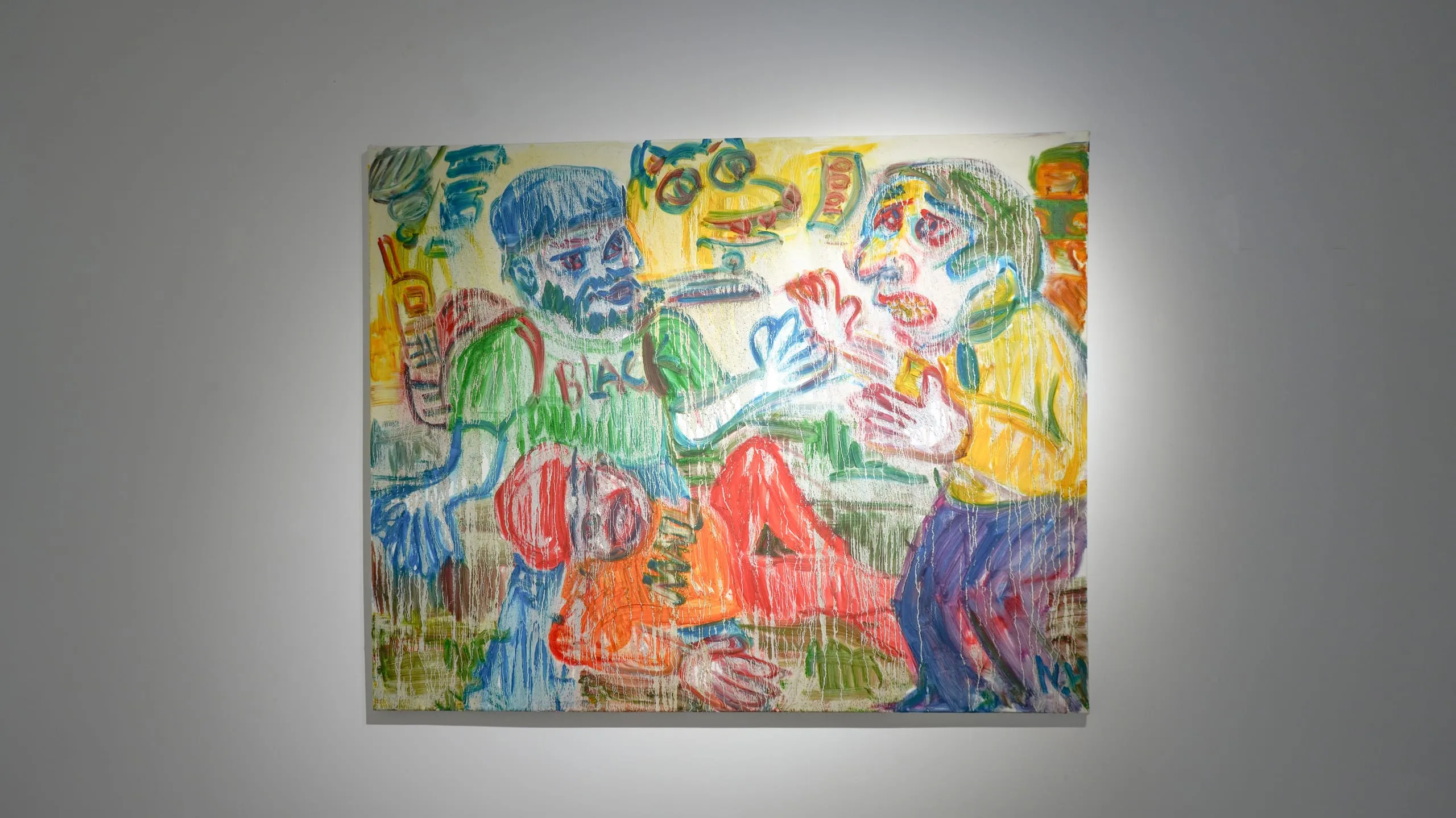
Wildmen
Figures stripped back to something rawer — an attempt at the more honest, freer relationships people might have with one another.
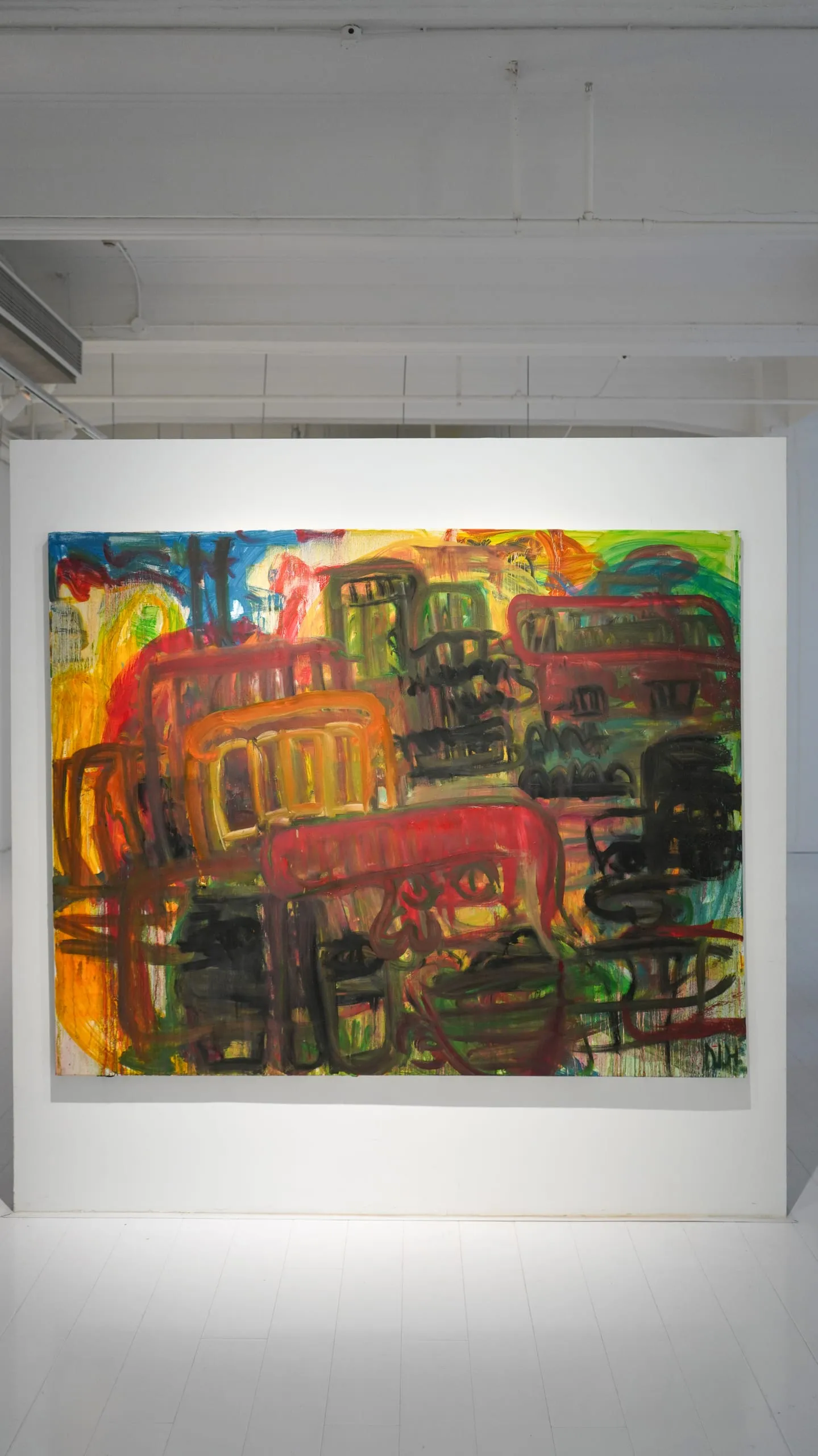
Film
Scenes lifted from cinema and collaged with the artist’s own reading of the story, until the borrowed image becomes their own.
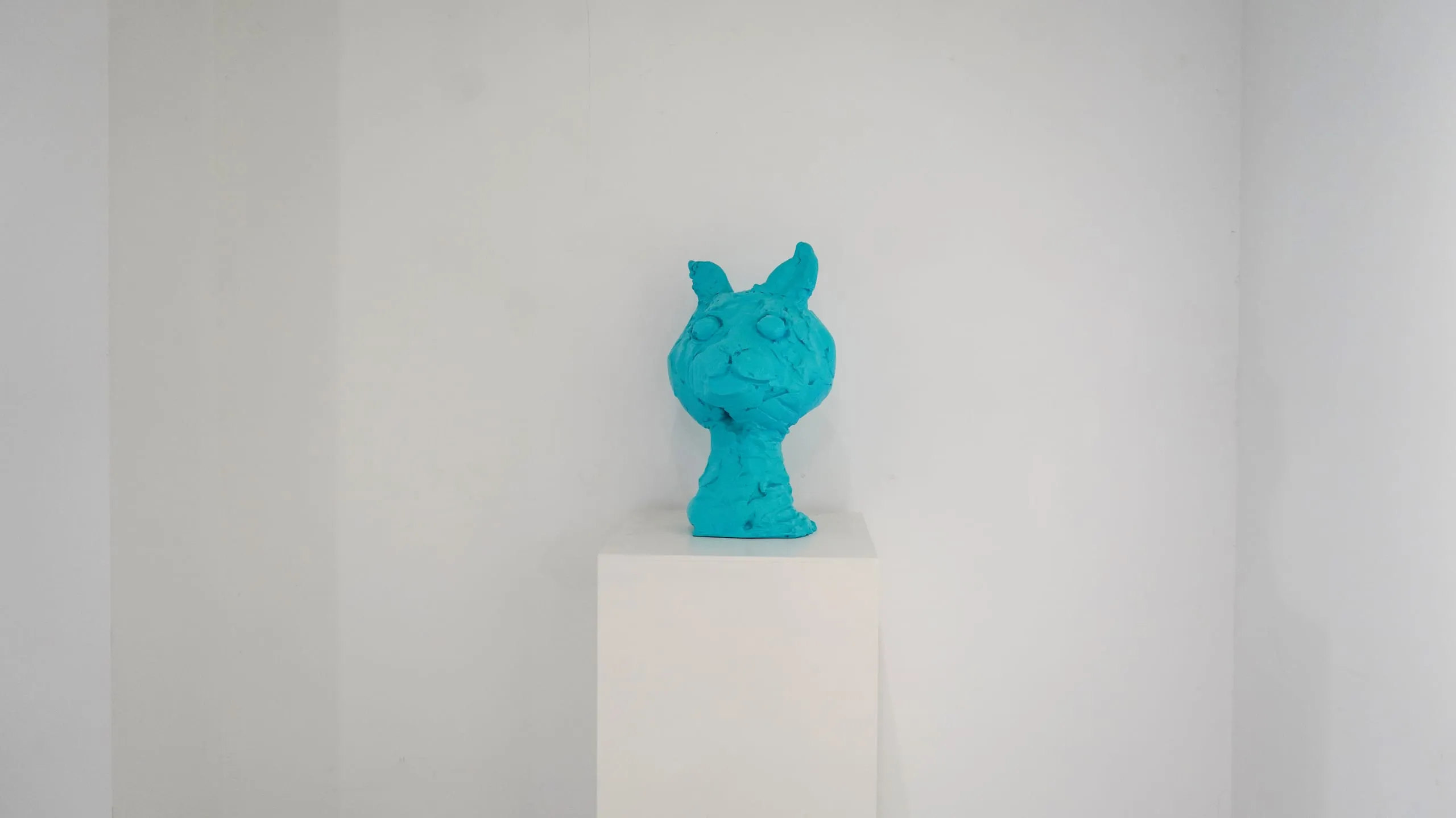
Animals
Cats and creatures painted for their spirit as much as their shape, each carrying a small narrative of its own.
Works & installation views
Documentation · 18 frames
Curator’s note — on letting paint lead
The artist hands half of each picture’s authorship to the painting itself — letting thinned pigment run and pool of its own accord, as if the paint were a collaborator with intentions of its own.
It is the logic Harold Rosenberg named action painting in 1952: the canvas not as a surface to fill but as an arena to act in. What gravity, the room, and a stray fleck of dust decide becomes part of the work — conflict and calm, the literal and the metaphor, held in the same restless frame. The hang keeps out of the way and lets that argument run wall to wall.
In conversation
Lena with the artist, in the weeks around the opening
- Why the bright, high-saturation colour?
- The colour comes from intuition. Saturated paint is more alive as it flows — and that aliveness is exactly what I’m after: a truer, freer image, and a freer state to work in.
- Why work so large?
- A big canvas simply has more room — to lay things out, to add elements and let the story get richer, and to leave space for the paint to run and for me to keep re-working it.
- The three rooms — Wildmen, Film, Animals — what do they mean to you?
- Each marks a stage of thinking. The animals lean on their spirit and a little narrative; the film works fold a story together with my own reading of it; the wildmen are about a more honest, freer relationship between people.
- Where does the work come from?
- My own experience, mostly — and films, books, blogs, documentaries.
- And when the inspiration isn’t there?
- Empty out. Go learn something from another field, or just go for a walk.
- How would you describe your style?
- Rough and real. In pursuit of freedom.
- How do you develop it?
- Keep trying, paint over, try again.
- What do you hope the work does, later on?
- Hard to say. They’re a snapshot of this stretch of my life — how I read the moment I’m in. I just hope they keep getting richer, and freer.